New safety regulations imposed by Ministry of Manpower (MOM) for engineers in Singapore.



Rockwool Slab vs Pipe Sectional: Which One Should You Use?
When planning an insulation system for an industrial project, one of the most common questions is whether to use a rockwool slab or a rockwool pipe sectional. Both are forms of rockwool insulation, but they are not interchangeable in every application. Choosing the right format affects installation quality, thermal performance, site productivity, and long-term maintenance.
For project owners, engineers, contractors, and procurement teams in Singapore, the best choice depends on the shape of the surface being insulated, the operating conditions, and the overall project objective. If the wrong product format is selected, even a good insulation material can become harder to install and less effective in practice.
This guide explains the difference between rockwool slab and rockwool pipe sectional, where each one is commonly used, and how to decide which is more suitable for your project.
What Is Rockwool Insulation?
Rockwool insulation, also known as stone wool insulation, is widely used in industrial and commercial projects because it combines thermal, acoustic, and fire-resistant properties in one material. Jereco describes its Rockwool insulation slabs as prefabricated porous light or semi-rigid rock wool boards made mainly from basalt and dolomite, with strong thermal, acoustic, and fire insulation performance. Jereco also states that the slabs can be finished with aluminium foil, aluminium glass cloth, or glass cloth depending on the application.
That combination makes rockwool suitable for many industrial settings where insulation has to do more than reduce heat loss. In real projects, it may also need to support safer surface temperatures, reduce noise, and contribute to fire performance.
What Is a Rockwool Slab?
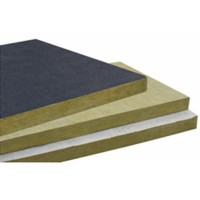
A rockwool slab is a board-form insulation product typically used for broad, flat, or large-radius surfaces. According to Jereco, its rockwool slabs come in different sizes, thicknesses, and densities to suit a range of mechanical and commercial insulation applications. The page lists thicknesses from 25 mm to 100 mm, densities from 60 kg/m³ to 120 kg/m³, and a standard size of 1.2 m x 0.6 m.
In practical terms, rockwool slabs are usually selected for applications such as:
-
tanks
-
vessel walls
-
deck and bulkhead construction
-
wall systems
-
floor systems
-
roof spaces
-
equipment surfaces and larger insulated areas
Jereco specifically notes that its slabs can be installed within walls, under floors, above and between roof spaces, and for thermal and acoustic insulation of deck and bulkhead construction, vessel walls, and large tanks.
What Is a Rockwool Pipe Sectional?
A rockwool pipe sectional is a pre-formed insulation product designed for pipework. Instead of starting as a flat board, it is shaped to fit around pipes more efficiently. This makes it the more practical option when the insulated surface is cylindrical and when consistency along pipe runs matters.
For many industrial systems, pipe sectionals are better suited for:
-
process piping
-
utility lines
-
HVAC pipework
-
mechanical services
-
exposed piping that requires a neater and more uniform finish
The main advantage is fit. A product shaped for pipes is typically easier to install on pipework than adapting slab material around curved surfaces.
The Main Difference Between Slab and Pipe Sectional
The simplest way to understand the difference is this:
A rockwool slab is made for wider surfaces and flexible cutting on site.
A rockwool pipe sectional is made specifically for pipes.
That difference matters because insulation should match the geometry of the application. A flat or broad surface usually benefits from slab insulation, while round pipework usually benefits from sectional insulation.
Trying to use slabs for every application may seem convenient at first, but it can increase cutting, fitting, and labour time on pipe systems. On the other hand, using pipe sectionals on surfaces they were not designed for is also not practical.
When to Use Rockwool Slab
A rockwool slab is often the better choice when the insulated surface is flat, broad, or irregular enough that board-form insulation offers more flexibility.
You should usually consider slabs for:
-
large tanks
-
vessel walls
-
enclosures
-
partitions
-
wall and ceiling applications
-
floor and roof-space insulation
-
deck and bulkhead construction
This is especially relevant when the installer needs to cut and adapt the material around supports, edges, corners, or changing surface dimensions. Slabs give more freedom in fabrication and can suit many industrial and commercial insulation layouts.
They are also a strong option when the project requires a combination of heat, sound, and fire performance in non-pipe applications.
When to Use Rockwool Pipe Sectional
A rockwool pipe sectional is generally the right choice when the substrate is a pipe and the project needs efficient, repeatable installation.
You should usually consider pipe sectionals for:
-
straight pipe runs
-
plant piping
-
service lines
-
HVAC and mechanical pipework
-
pipe systems where consistent insulation thickness matters
-
projects requiring cleaner pipe insulation detailing
Because the product is already shaped to suit pipework, installation can be faster and more uniform than trying to cut flat slabs for the same purpose. This is particularly valuable in industrial settings where there are long pipe runs and multiple service lines.
Which One Is Better for Pipes, Tanks, and Vessels?
For pipes, the answer is usually straightforward: rockwool pipe sectional is the better choice. It is designed around the shape of the pipe, making it easier to achieve a more accurate fit and a more efficient installation process.
For tanks and vessel walls, rockwool slab is usually the more suitable option. Jereco specifically lists vessel walls and large tanks among the applications for its Rockwool insulation slabs.
For other industrial equipment, the right choice depends on the shape and surface condition. Broad or flat equipment surfaces often lean toward slabs, while cylindrical service components may be better suited to sectional insulation.
Factors to Consider Before Choosing
The right product type should not be selected based on habit alone. Buyers should review a few practical points before requesting a quotation.
1. Surface Shape
This is the first and most important factor. Flat and broad surfaces usually point to slabs. Round pipework usually points to sectionals.
2. Installation Efficiency
If a product can be installed with less cutting and less adjustment, it often improves labour efficiency and consistency on site.
3. Thermal, Fire, and Acoustic Needs
Jereco highlights that its rockwool slabs provide protection against noise, heat loss, and fire. If the project involves these combined requirements across non-pipe surfaces, slab insulation can be a strong choice.
4. Thickness and Density
Jereco’s slabs are available in multiple thicknesses and densities, which is useful when the project needs a more tailored insulation specification.
5. Finishing Requirements
Some projects need a facing or finish depending on the installation environment and end-use. Jereco notes that its slabs can be covered with aluminium foil, aluminium glass cloth, or glass cloth depending on requirements.
A Practical Rule for Industrial Buyers
If your project is mainly about insulating pipes, start by looking at rockwool pipe sectional.
If your project is mainly about insulating tanks, vessels, walls, floors, roof spaces, or broad equipment surfaces, start by looking at rockwool slab.
If the facility includes both pipework and larger insulated surfaces, the most effective approach may be to use both products in different areas, based on their intended application.
Final Thoughts
Choosing between rockwool slab and rockwool pipe sectional is really about matching the insulation format to the job. Both are valuable forms of rockwool insulation, but each performs best when used in the right application.
For pipes, pipe sectionals usually offer the better fit and installation efficiency. For tanks, vessel walls, and other broad surfaces, slabs are often the more practical solution. Jereco’s Rockwool insulation slab range is positioned for a variety of mechanical and commercial uses, including deck and bulkhead construction, vessel walls, large tanks, walls, floors, and roof spaces.
For industrial projects in Singapore, the best results usually come from choosing insulation based on the surface, performance requirement, and installation method, rather than treating every rockwool product as the same.
If you are comparing options for your next project, Jereco can help you assess whether a rockwool slab or rockwool pipe sectional is more suitable for your application.